MYRIAM CASPER

Washi: Japanese Paper
Produced from the harmony of humans and nature, handmade washi possesses great strength, kindness to people and the environment, and above all a beautiful, exquisite texture.

The story I want to share today is about the fusion of culture & art from East to West, driven by passion & dreams of several artists. It involves ancient tradition and native stories. All laid out on a unique piece of art, born out of carefully selected raw materials and a painstaking process of hand production that has remained essentially unchanged for centuries, WASHI, the handmade Japanese paper.
Wa means Japanese, Shi means Paper. Washi is a perfect example of the four principles of Japanese aesthetics: purity, tranquility, harmony, and respect. It’s a perfect manifestation of that culture.
Produced from the harmony of humans and nature, handmade washi possesses great strength, kindness to people and the environment, and above all a beautiful, exquisite texture.
This project is dear to my heart for many reasons. One of the reasons I can tell you right now, is the idea of washi paper being the “container” holding the work of several artists. This is the type of paper that emphasizes the soul of the image created on it. It adds depth and richness to a painting or a photograph. Touching the paper feels warm and alive.

Tesuki washi was invented in A.D. 105 by a Chinese official named Ts’ai Lun. In ancient times writings and inscriptions were generally made on tablets of bamboo or on pieces of silk called chih. But silk being costly and bamboo heavy, they were not convenient to use.
Ts’ai Lun then initiated the idea of making paper from the bark of trees, remnants of hemp, rags of cloth, and fishing nets.
Washi was introduced to Japan in A.D. 610 by Doncho, a Buddhist monk from Korea. From then on, the art of handmade washi has been maintained and preserved.
By the Edo period (1603-1867) was popular among Osaka merchants for use in account books. Whenever a fire broke out, the merchants did not hesitate to throw their account books into a well to protect the records; the merchants were not worried about the paper being damaged by the water.
Washi has for centuries also gather attention beyond Japan’s borders. The Dutch painter Rembrandt was already experimenting with washi around 1650, Pablo Picasso and Marc Chagall were among the later artists to fall under the spell of Japanese paper. Also an essential element in many art preservation projects, including the restoration of Vatican frescoes old paintings. In Canada, Inuit artists of Baffin Island community have made over one hundred thousand original drawings and thousands of limited edition prints. Their images of the many species of Arctic wildlife, shamans, hunters, and traditional camp life, convey the mystique of Canada’s far north.
As a Japanese craft it registered as a UNESCO intangible cultural heritage.


We visited Mr. Kubota’s family where whole family and some apprentices work on this beautiful craft studio in the small town of Misumi-cho in Hamada, Shimane Prefecture.
THE MAKING OF WASHI

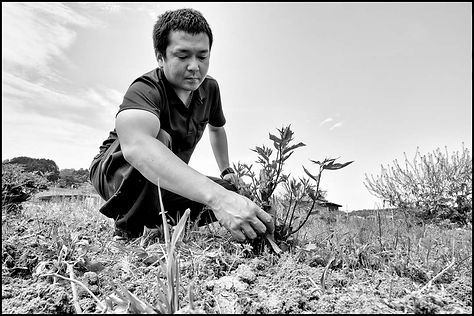
The paper is made from the fibers of the mulberry tree. In the area we visited there are three types of washi paper, kozo, mitsumata, and gampi. KOZO is the one we have come here to photograph/ to document.
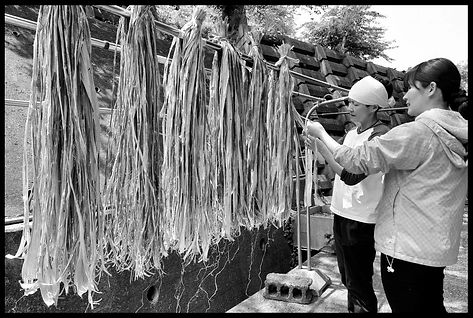
To become a KOZO paper, the fibers are SOAKED, STEAMED, STRIPPED, SCRAPPED, BOILED, WASHED, POUNDED, THICKENED, FILTERED, until finally left in the sun to DRY. The making of washi is one of the most labor intensive processes in the world and has no parallel.